
During Holy Week in Carmel, we enter into a deeper silence as we reflect on the mysteries of Christ’s Passion, death and Resurrection. Here we share some insights of the Saints of Carmel about the mysteries of Holy Week:
“It is very consoling to think that Jesus, the Strong God, knew our weaknesses, that He trembled at the sight of the bitter chalice that He had in the past so ardently desired to drink.”
(St Thérèse of Lisieux; LT 213)
“By his hour on the Mount of Olives, he prepared himself for his road to Golgotha. A few short words tell us what he implored of his Father during this most difficult hour of his life, words that are given to us as guiding stars for our own hours on the Mount of Olives. ‘Father, if you are willing, take this cup away from me. Nevertheless, let your will be done, not mine.’ Like lightning, these words for an instant illumine for us the innermost spiritual life of Jesus, the unfathomable mystery of his God-man existence and his dialogue with the Father. Surely, this dialogue was life-long and uninterrupted.”
(St Teresa Benedicta of the Cross; The Prayer of the Church)
“Let us lovingly eat this bread of the will of God. If sometimes his will is more crucifying, we can doubtless say with our adored Master: ‘Father, if it is possible, let this cup pass me by,’ but we will add immediately: ‘Yet, not as I will, but as You will’; and in strength and serenity, with the divine Crucified, we will also climb our Calvary singing in the depths of our hearts and raising a hymn of thanksgiving to the Father. For those who march on this way of sorrows are those ‘whom He foreknew and predestined to be conformed to the image of His divine Son,’ the One crucified by love!”
(St Elizabeth of the Trinity; Heaven in Faith 30)
“If you are experiencing trials or are sad, behold Him on the way to the garden: what great affliction He bore in His soul; for having become suffering itself, He tells us about it and complains of it. Or behold Him bound to the column, filled with pain, with all His flesh torn in pieces for the great love He bears you; so much suffering, persecuted by some. spit on by others, denied by His friends, abandoned by them, with no one to defend Him, frozen from the cold, left so alone that you can console each other. Or behold Him burdened with the cross, for they didn’t even let Him take a breath. He will look at you with those eyes so beautiful and compassionate, filled with tears; He will forget His sorrows so as to console you in yours, merely because you yourselves go to Him to be consoled, and you turn your head to look at Him.”
(St Teresa of Avila; Way of Perfection 26:5)
“At the moment of his death he was certainly annihilated in his soul, without any concolation or relief, since the Father had left him in that way in innermost aridity in the lower part. He was thereby compelled to cry out: ‘My God, My God, why have you forsaken me?’ This was the most supreme abandonment, sensitively, that he had suffered in his life. And by it he accomplished the most marvellous work of his whole life, surpassing all the works and deeds and miracles that he had ever performed on earth or in heaven. That is, he brought about the reconciliation and union of the human race with God through grace. The Lord achieved this, as I say, at the moment in which he was most annihilated in all things: in his reputation before people, since in watching him die they mocked him instead of esteeming him; in his human nature, by dying; and in spiritual help and consolation from the Father at that time, annihilated and reduced to nothing.”
(St John of the Cross; The Ascent of Mount Carmel, Book 2:11)
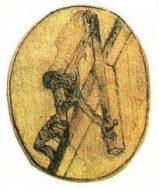
“The world is in flames: do you wish to put them out? Contemplate the Cross: from the open Heart the blood of the Redeemer pours, blood which can put out even the flames of hell……Through the power of the Cross you can be present wherever there is pain, carried there by your compassionate charity, by that very charity which you draw from the Divine Heart. That charity enables you to spread everywhere the Most Precious Blood in order to ease pain, save and redeem.”
(St Teresa Benedicta of the Cross; Address for the Feast of the Exaltation of the Cross, 1939)

