
Saturday 30th January
For the next two days we met in separate groups according to our different forms of life: the Ordo Virginum (the oldest form of consecrated life in the Church), Cloistered Monastic Life, Religious Institutes of Apostolic Life and of Male Monastic Life and Societies of Apostolic Life, Secular Institutes, New Institutes and “new forms”.
Our contemplative group was privileged to spend these days in the Vatican City, based at the Urbaniana. Saturday and Sunday both began with Mass at 8.30 in the Chapel. Mass was in Italian, but we had been supplied with prayer booklets giving the readings in English, and various languages were used for the readings and in the homilies. It was interesting that the representatives of English all seemed to be Indian or African! The singing was led by a group of sisters. I was struck time and again by the quality of the singing. Maybe it was the presence of so many Italians! Anyway, the sound was beautiful, and it also sounded as though people really wanted to sing.
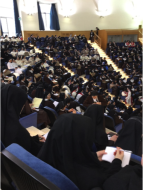
After Mass we walked down to the building where we had had lunch the day before, and assembled in the Aula Benedetto XVI. During the preliminaries members of different orders were asked to raise their hands. When it came to our turn there were so many more of us than of any other order that a spontaneous cheer erupted! The programme that had been arranged for us for these days was based on our responses to the questionnaire sent out by the Congregation last year. Apparently it was one of the most successful questionnaires they have ever known. 2,596 monasteries (out of about 4,500) responded, and while there was great diversity in the responses, it became clear that we cared deeply about how we live our life. A team had spent three months studying our responses and had produced both a long summary and a short summary. The Congregation have adapted the document on cloistered life (which had been produced in 2008 to update Sponsa Christi but had not been promulgated) in the light of our responses, and this revised document is now in the hands of the Holy Father. They said they knew it was not going to please everyone but they hoped it would be seen as a step forward…
On the Saturday we had two talks in the morning. The first was from the Prefect, Cardinal Braz de Aviz. His subject was Fraternal communion in the monastic community. He is a friendly and gracious man, not a religious himself, but appointed as Prefect by Pope Francis. He lives with four sisters, so claimed to be living in a mixed community, and told a story of how he upset one of the sisters and realized he needed to apologise and change his ways!
He said we must have the courage to enter into the mystery. It’s a mystery of love. The gaze of God – that is the end. We have to develop the capacity of entering into this reality. Philosophies are not able to show us the way – only Jesus, who gave us the Trinity. He draws us to the point where we can enter into the relationship between the Three Persons.
We need to understand that we can take a step forward into love – into mercy (they are the same thing). The life of love is fundamental for us.
Cloistered life draws us into communion. Relationship with the sisters cannot be separated from relationship with God. Fraternal life is a space where we experience the mystical presence of the risen Christ; from fraternal life we can generate the presence of Jesus in our midst. If we love one another, Jesus is reborn in our midst. We’ve got to grow in awareness of this fact. We can help one another to progress together with one heart and mind.
The Gospel is very precise: ‘From this they will know that you are my disciples.’ Some of our communities are dying from solitude – the members do not find the possibility of profound relationship with the others. We may think: ‘In order to pray, I have to be far away from that person.’ In that case, fraternal life is the best penance! Forgiveness is essential. We have to take great care of this. Would I be willing to die for this person? Only if I answer ‘yes’ can I correct her.
Communion is very important for religious life, and in a particular way for contemplative life. The beauty of communion is a manifestation of that love which, coming from the heart of the Father, fills us and shows us the way. In other words, it is Jesus.
I have no other dignity than my baptism. The Church is the family of God – the baptized children of God. Baptism is a sign of a profound union with God. This relationship of communion manifests God in the world. The monitor of our relationship with God is how we love one another.
Communion of goods is important. Also showing affection. (‘Touch one another. Give a hug. Give a kiss!’) Don’t be afraid. Chastity doesn’t mean cancelling our humanity, becoming cartoon characters, not useful for anything. We need to be educated about sexuality. God created man and woman, and we need to listen to one another. We each have different dimensions, and we must make the journey of acquiring the dimensions of the other sex.
We were attracted in the first place by the gaze of Jesus who called us. We want to live with one heart and soul the Trinitarian life. So we need to journey together.
This involves a change of mentality; cf. Phil. 2: 5-11. We tend to be focused on ourselves as individuals, and have cut one of the most beautiful roots of the Gospel: the person. There is no person without relationship. ‘Make your own the mind of Jesus Christ’ (2: 5): i.e. the capacity to be detached from selfish desires. But there is more. Love enabled him to lower himself, and to die along with human beings. And so he was able to give us salvation, through giving us himself.
We have an immense difficult in having human relationships. We’ve got to change. The first thing to do is listen to the other, become small in the presence of the other. When people come to the dicastery, if they are willing to listen and to enter into suffering, the relationship changes, and everything becomes possible through fraternal communion.
Don’t ever think that the Church is far from you! You are Church. Your Spouse is capable of many things. If you are suffering, remember that he makes the dead rise up! But if you go away, he won’t find you. Suffering is the work of the Spouse in you. This is the very rule of formation.
There followed a break, and to our delight the caterers were already there, dispensing 800 cups of coffee and two or three thousand delicious little cakes and pastries.
We returned, duly fortified, for a talk by Sr Fernanda Barbiero, SMSD, on Formation in the Monasteries: the legacy of the past and openness to the future. Allain and I were both very impressed by Sr Fernanda. She is the Editor of Consacrazione e Servizio, President of the Italian Union of Major Superiors, and teaches at a couple of universities. She regularly collaborates with the Congregation and she headed the team that studied our responses to the questionnaire. She also has experience of accompanying several contemplative monasteries. Her talk is already available in an English translation by Sr Camilla COLW, and it is well worth reading in full. A shortened form is given here.
Sr Fernanda began by saying she thought that at this symposium we were inside a historical event of the Church which was very important – perhaps we did not realize how important. We should all be thankful to the Church for having made it possible.
She also said she had found great richness in the responses to the questionnaires. Formation emerged as the most important issue, and there was a widespread push towards a new vision. A change of perspective was needed, from content to process. It is essential for us to learn to learn – then we will be able to form others.
We need wide horizons: monasticism is a vision of the meaning of our life in this world of space and time – a vision that proceeds from faith. In involves the constant pursuit of the fullest sense of what it means to be human, which finds its beginning and end in the incarnation.
Formation must be a profound experience of the human heart, transformed and renewed by the presence of God. It has the responsibility of promoting the inherent identity of the person called and of leading her towards a joyful deepening of her vocation – ‘to be transformed into the image of Christ.’
The theme of the image of God is central in the roots of monastic spirituality. For the Fathers, monastic life was not a reality in which someone could be formed: on the contrary, it was a condition of life through which one allowed oneself to be formed into the image of Christ. The centre of monastic life is the search for a relationship with God, and it becomes increasingly clear that the initiative for this search is in the hands of God. Monastic life cannot be invented; for this reason, it can only be acquired from a tradition that has its roots in the early centuries of the Church.
Furthermore, monastic life ceases to exist if there is no fidelity to the contemporary history of man: living insecurity with love, walking while being led, accepting not to have the answers.
Formation is accomplished primarily through things that are known, by values that are lived. The cloister allows the nun to participate in the Son of God’s acceptance of limits – both in the Mystery of the Incarnation, in which the Word enclosed his divinity within the womb of Mary, and in the Paschal Mystery, in which Christ accepted the extreme limitation of death in order to open it to an abundance of life. The cloister is a privileged space for forging an exclusive union with the flesh and the cross of Christ. The contemplative experience, then, is itself strongly formative.
The real educator is the Holy Spirit. If we receive the person as a gift from God, we quickly discover that the vocation – human, Christian, and monastic – is an identity already written in her with the divine call; the job at hand is to help it come to light and make it grow.
In our times, when scientific knowledge is the only form of knowledge accepted as valid, we need to reclaim the great medieval tradition of the monastery as a school where one searched for the deeper meaning of life.
The driving force of the monastic search is the ability to live in the presence of a hidden God, finding Him in the Word and in the community. The monastic community is not a group where one goes to fulfil a project. There is no project! It is something that receives life and a face from the Trinitarian communion. ‘As the Father has loved me, so have I loved you,’ says Jesus. These are not just beautiful words: it is a continuous work on oneself, so as to live life as a gift of self to others. All are committed to helping each other grow. This brings beauty and joy to community life.
To form, in the monastic sense, means to guide a person into learning a lifestyle that becomes more and more a way of thinking, loving, and acting. After all, there is no growth in formation if life does not express the vocation, namely a life that makes clear the gaze of love that God has for us.
‘Make your own the mind of Jesus Christ’ (Phil. 2: 5). To have the same mind as Jesus Christ means to live in obedience to the Father, embracing our humanity through and through, as it is after sin, and to bring this humanity back to the Father by living as His children. The aim of formation is to make the divine life shine in the human form. Formation has no other basis. To achieve this goal it must be attentive to all the dimensions: intellectual and emotional, individual and communitarian, personal and social, emotional and sexual.
There is an urgent need for a formational pedagogy directed at the heart, so as to make it capable of welcoming life as a gift to be received, and to be shaped within the Paschal Mystery. Some aids to this are: silence, solitude, waiting, and self-knowledge. We are called to incarnate the divine nature: this is what it means to have the mind of Christ. This is something more than, and different from, imitating a model. We share in the very life of God, as ‘partakers in the divine nature’ (2 Pet 1: 3-4). The nature of God is holiness; it is love. We participate in the life of the Trinity in the same way as we breathe in air: by living.
Monastic life is discovered by living it, because it is a hidden life. Life is not something managed; it is something received. The elements proper to the whole contemplative monastic tradition need to be retrieved and their validity affirmed, because they promote a process of integrated growth. These elements are: Lectio Divina (understood as listening to the Word and learning to dwell within it), the Liturgy (above all the Eucharist, as the memorial of Christ’s sacrifice, and the heart of the life of the Church and the community), asceticism (the continuous path of conversion with a view to conforming one’s life to Christ), and work (providing balance, and solidarity with the poor and all who earn the bread they eat).
The vocation of the nun is not to do good, but to become like Christ. Therefore formation should demonstrate the gift of God in Christ, who gave himself completely, and should always concern itself with our freedom and with Easter.
The monastic experience is transmitted essentially in and through the life of the community. The spirituality of communion is the summit of human history according to God. It comes into being in the fraternal living of everyday life, as the ground in which one grows in the evangelical quality of relationships and from which all the fruitfulness of the life derives. It is here, in the spirituality of communion, that we must find the founding principle of monastic formation.
The profound relationships that can develop within the community both enable personal growth and are an expression of the sacramental mystery of the Church. The community is a source of knowledge, and allows one to discover one’s own need of conversion. In it we easily recognize ourselves as a community of sinners who have all been forgiven, and in it we are given the opportunity of being transformed through the practice of fraternal charity. Otherwise a lack of communication causes the spiritual experience to take on individualistic connotations.
The most common cause of discouragement in monastic communities today is the lack of vocations; or, even worse, the lack of perseverance in vocations that have failed at some point. I am convinced that a renewal will not start from an analysis of the current sociological reality, but from a new awareness of the monastic heritage, and from the ability to question the responsibilities and tasks assigned to nuns. We need to grasp the way in which monasticism is effective today.
The most important thing today is to think – to think with our heads! (Applause.)
Vocational discernment is a fundamental prerequisite. Then one must consider the person’s actual docility to the work of grace, the natural aptitudes that are the premise for a firm rooting and flourishing of the gift of vocation. Another aspect to be considered today is the introduction of foreign vocations into monasteries. The motivations and formative capacities of candidates are not always considered as carefully as they should be.
Today the norm is that women who approach us have problems, sometimes even serious problems, on a psychic level. Without tools we are not at all able to deal with such situations. Therefore there is an immediate and urgent need to help those called to the service of formation; proper training of suitable people can only be provided outside the monastery.
It is very important for each monastery to have its own ratio formationis, showing how to pass on the charism and the means to live it in the different stages of life, whilst progressing towards a full maturity of faith in Christ. It is essential to guard against the ‘charismatic disaffection’ that generates a lot of confusion and instability among contemplatives. There is, however, a need to rethink the ratio, especially in relation to the specifically feminine contemplative vocation in the Church. It is important to consider this point attentively if one is not to pay the price for a lack of vision of one’s own identity and corporeality. We need to foster spiritual women capable of living for the other and thanks to the other, in the logic of a spousal and maternal dimension.
The strength and richness of feminine contemplative life lies first and foremost in a silence that is listening to the Word. Where women of prayer have been able to safeguard this fruitful silence, they have exercised myriad uncodified ministries and expressed a word, at times decisive, in the history of the Church and of humanity.
Today nuns struggle to make their voice heard; perhaps they must find it again, together, outside of any predetermined idealization and simply by exposing themselves to the power of the Gospel. The language of the cloister in itself speaks of the Gospel to those who live in enclosure. The unification of the heart, the dynamism proper to monastic life, urgently needs to be revived today as empathy, as a conscious exposure to dialogue within the culture of fragmentation, of complexity, of precariousness. In these terms I understand the insistent call of Pope Francis to nuns to understand themselves as “women emerging”.
The rules regarding enclosure put people in opposing camps regarding formation, and the issue is complex. But a certain form of papal enclosure appears to be based on a logic of privilege, now more than ever equivocal. This seems to be a unanimous feeling across the various expressions of female monasticism: Poor Clares, Carmelites, Benedictines, and also the new monastic orders.
The future of monasticism will be what we make of it. In the words of the prior of the Cistercian Abbey of Boquen in Brittany: “The modern world needs monks; that is, people advanced on the path of their unity and their inner freedom, who live, not in the nostalgia of past centuries, but in the heart of this twenty-first century that is both exciting and devastating, and also, if possible, looking ahead to the twenty-second century … It’s up to us to contribute to the elaboration of the synthesis that will replace those that have undoubtedly enlightened past centuries, but have now had their day.”
It should be noted that monastic life is the constant return to an exodus of faith, because one surrenders to God in a covenant without conditions; for He, and He alone, is faithful always. Monasticism is emerging! It is emerging with hope! Because hope is nourished by listening, contemplation, and patience. “Are we able to wait for the tomorrow of God, or do we want today?” We need “an attitude that always looks towards tomorrow” (Pope Francis).
Monastic life offers a particular vision of the meaning of human experience that derives the fullness of its content from the Son of God: a meaning of life and destiny so radical that it can lead our world to an experience of new and authentic humanity.
That day our kind Provincial, Fr Michael McGoldrick, had instructed Brother Noel, who is studying in Rome, to take the Irish sisters out to lunch. Monica and Brenda graciously extended the invitation to include Marie Thérèse (an Irish sister in Calcutta), Allain and me, and Lucia and Bernadette from the Netherlands. Brother Noel seemed unfazed! He led us to a very pleasant restaurant near St Peter’s and we had an extremely enjoyable and convivial time together, sitting outside enjoying blue skies and sunshine.
In the afternoon session, the plan had been to divide into groups for each Order, but this was changed to language groups, somewhat to our relief! There were four English-speaking groups, each with about twenty participants. Our group included two Visitandines (Sr Mary Joseph from England, and another sister from America), and all the rest were Carmelites – from Australia (Jennifer), Korea, Japan, India, and America (Sr Mary Clare from Chichester / Terre Haute, and Sr Angel).
We were asked to discuss the questions:
What signs of vitality can be seen in monastic life today?
What challenges does formation present to the monasteries for the future?
It was a very valuable time of sharing. Up until that time we had had many precious and enjoyable exchanges over meals and at other moments, but this was the first opportunity for a sustained discussion of issues affecting us all, and we quickly established a sense of warmth and solidarity. Some of the things that came out of the discussion were (in no particular order):
- There is joy and passion, even in ageing communities, and this speaks to people.
- The importance of the internet (website, facebook, blogs, and twitter) as a way of making our presence and way of life known. (Twitter need not be as superficial as it sounds! For instance, Allain said that Sr Dorothy ‘tweets’ a quotation from St Teresa every day.)
- Initial Formation Meetings (Britain and Australia, and started in Korea last year), enabling sisters in formation to get to know each other and share experience. In India sisters in first vows spend six months together for formation in one Carmel, with classes given by sisters from that Carmel and some other Carmels. They are freed from community work, but otherwise live a regular Carmelite life. It works well and is greatly appreciated.
- In Australia a lot of work has been done on training formators.
- Much was said about the need for careful assessment of vocations and thorough formation. In Korea they now allow 7 years before Solemn Profession. This care was seen as a sign of vitality.
- Challenges:
meeting women where they are now (individual formation is ideal);
teaching people how to learn;
having suitable personnel for formation;
the enormous adjustment involved for most women entering now (in some cultures, e.g. Japan, the people who want to join often have very little knowledge of religious life, or even of Christianity);
discerning the use of media and technology, and sifting resources;
adopting suitable methodology;
intercultural relationships (especially in America);
smaller families means fewer vocations – fewer vocations means more work
in communities – more work means a hard life! The advantages and disadvantages of employing lay help.
A secretary produced a brief report from each group, and the day ended with an hour’s prayer in the chapel.
Sunday 31st January
The first talk on our second day at the Urbaniana was given by Fr Sebastiano Paciolla, O.Cist., Undersecretary at the Congregation, on The autonomous monastery: potentialities and limitations.
Fr Paciolla began by commenting that some new conditions affecting religious life in general are also present in monasteries e.g. a lack of trained and competent persons for authority, formation, and the administration of temporal goods. In this situation, autonomy can hinder the provision of help from outside.
He listed the different realities to which the term ‘monastic life’ may be applied, and explained that he would be considering both the traditional form of monasticism and the extended feminine form of institutes of consecrated life bound by vows.
The ‘autonomous monastery’ is properly a house sui juris, whose superior is a major superior, and whose goods are Church goods. True autonomy of life must be assumed – that is, the ability to manage its life in all spheres. A monastery is founded keeping in mind its usefulness first to the Church and then to the Institute.
Proper autonomy is both de jure and de facto. Sometimes the number needed to constitute a sui juris monastery (intended as a minimum starting-point) is made up at the expense of vocational discernment, and the minimum number is taken as a final goal. And even if a monastery has a large number of monks or nuns, if it is not clear who can fulfil the various tasks, it cannot be considered to have true autonomy.
There are three types of monasteries:
- Those congregated among themselves;
- Those associated with an institute of men;
- Isolated monasteries under the local bishop.
The Code of Canon Law safeguards the autonomy of sui juris monasteries in all these categories.
For monasteries associated with a male branch of the Order, the Constitutions should define the power of the male superior with regard to the monastery. There is a natural association when one belongs to the same Order, even if there is no juridical relationship with the male Institute.
The term ‘association’ is not free from ambiguity. There also exists a voluntary spiritual association without belonging to the same Order (Canon 614). Mutual rights and obligations are determined to promote spiritual benefit.
Most of the monasteries of women in the Church are isolated monasteries, with no other superior than their own. They are ‘entrusted to the special vigilance of the diocesan bishop’, but must not be considered as diocesan monasteries.
Since Sponsa Christi (1950) and Perfectae Caritatis (1965), federations and associations have multiplied. They differ from monastic congregations of women in that:
- They are not religious institutions;
- They are not government structures, but structures of communion;
- They do not have a president who is a major superior;
- They do not have a General Chapter but a Federal Assembly.
Autonomous monasteries can join a federation or association while maintaining their own juridical structure.
The supervision of monasteries of women is guaranteed mainly by the visits of the external visitator. Each female monastery is entrusted to a specific form of supervision, defined in their own Constitutions.
All autonomous monasteries of women enjoy internal independence. The limits of the diocesan bishop’s powers and duties are defined in their Constitutions.
Problems
At what time must one declare that a monastery no longer has the ability to fulfil all the conditions of a sui juris house? In the Congregation’s experience, it can be very difficult to change the superior; there is ever more frequent recourse to postulation. It can be very difficult to identify people who could become formators. Many communities are not in a state to accept new vocations: if it is not possible to guarantee a real human, Christian, religious, monastic formation, it is not honest to accept new vocations. The Congregation receives thousands of requests for dispensations from vows every year. There is an increasing trend to accept vocations from abroad to prevent the closure of monasteries (what Pope Francis calls the ‘trafficking of novices’). For the whole of religious life, initial discernment has become more difficult and delicate. Good initial and ongoing formation is essential. Canonical visitations are sometimes neglected for many years. Or the bishop may exert pressure to keep a monastery open even though everybody knows that the religious life is not being lived properly there. It is not the number of sisters that counts, but the quality of witness.
Future Prospects
In areas of new evangelization, it is necessary to ensure that people with the necessary qualities are available for any new foundation.
Perfectae Caritatis allowed the Holy See to forbid monasteries to receive new members if it discerned a lack of scope for future development. But nothing has been done, because of a false mercy. Many situations are now extremely negative because in the past no one was able to speak the truth.
Ecclesiae Sanctae made provision for suppression. The dicastery has established an institute of affiliation for monasteries without proper autonomy of life. This can either be temporary, to help them overcome difficulties, or irreversible, to enable them to enter into suppression.
It is necessary to take steps to activate a system of dependencies between viable houses and those not able to fulfil all the requirements of autonomy but still able to be a presence. The criterion for suppression is the usefulness of an institute to the Church. Existing structures of collaboration such as associations and federations can be used to implement such dependencies. Congregations and federations can supply the logical balance between autonomous monasteries and the need for a central authority. Many monasteries are not yet federated: it is important that they should come in.
After this, we needed a cup of coffee! We returned for a talk by Mgr Carballo on The biblical-theological foundations of cloistered life. Mgr Carballo, being a Spaniard, tends to shout and wave his fist in the air. This can be a little trying. However, I liked his talk very much. Allain, on the other hand, prudently applied a hermeneutic of suspicion, and wondered if it might be a prelude to an instruction to us women to stay in our proper place… I suppose all will be revealed when the new document is published.
Mgr Carballo admitted that the subject he was addressing was a complex and difficult one. He said that this was the first time in history that all charisms had been called to Rome, and that it had happened at the specific request of the pope, who recognized that at times cloistered nuns were reluctant to meet.
Mgr Carballo described cloistered life as ‘a life for love of the Spouse, a life that leads from solitude to new relationships.’ The cloister exists for contemplation, and for nothing else. This understanding had emerged clearly from our responses to the questionnaire.
Everything we do must be for the sake of this hidden treasure of contemplation. Like Jeremiah, we had been overwhelmed by the call of God, and had fixed our gaze on the One who had called us to Himself – the One who loved us first. We should put ourselves entirely at the service of the quest for God, always travelling, not with our feet, but with mind and heart, always seeking God. As we walk, we travel along the edge of two abysses: the fullness of everything, or the most absurd emptiness. There is no half-measure.
Our life is not only a radical life, but a prophetic life in the most profound sense of the term. We must know how to hear the questions of God and see His presence in a world that ignores Him. ‘Don’t forget the world when you go to Choir’ – we need to carry the sufferings and joys of all people in our hearts.
As Elizabeth of the Trinity said: ‘If He didn’t fill the cloister, how empty it would be.’ Our life is one of profound communion, with Jesus and also with humanity. A passionate love for Jesus is the motivation for entering the cloister, and is also what sustains life within it: a desire to be with Him without distractions; to love the One who gave Himself entirely out of love for us.
The cloister is fundamentally a matter of the heart, an enclosed intimacy with the Spouse – the one thing necessary. To whom much is given, from them much will be sought. As St Paul said, ‘Get to know your vocation.’ Reflect on your formula of profession; remember what you are doing. Keep close to Him, until you are transformed into Him by love.
The life of the cloister also entails penance, which is always inseparable from love. Do not fall into false solitude: love one another. Joy is constitutive of the Christian faith. It is a responsibility, not just a possibility. This is the summit of contemplative life: joy even in the midst of tribulations, even in company with sisters we would not have chosen to live with.
We enter into the desert, in order to separate ourselves from (a place of solitude) and for (a place of listening, intimacy) (midbar means both ‘desert’ and ‘listening’). We are to live the encounter with Christ, from temptation to the most radical freedom. Solitude can be negative: it can be isolation. This is the root of many problems in our monasteries. Community is not enough; we need fraternal communion. On the other hand, solitude can be positive: a movement towards the other, a lived solitude, not just an absence, but a space for listening to the Word of the Father.
Only in this way can you cope with crises in the cloister. Crises occur when, for example, you take things easy, or when the means of communication (internet etc.) are used without discretion. We have to take things seriously as God takes us seriously. Or we can create a crisis if we identify the cloister with physical enclosure – without soul, without mysticism. A mere material obedience is not enough. The essence of cloister is love.
Cloister is a space for relationships. You can only be a contemplative if you have experienced yourself as loved by God. Then you can foster real fraternal life in your monasteries. Don’t make ‘silence’ always your topic!! You may keep the silence without doing what you are in the cloister for. A monk recently took his own life for lack of fraternal communion. Don’t keep silence! Speak up when it is needed.
Be sensitive to creation. Give yourself time for yourself and for your community. Too much work is a problem. [He didn’t suggest what the solution might be!]
A crisis is a time when you need to make a decision. We should make decisions out of faith – not just to maintain the structures of our monastery. Don’t be afraid. The cloister as it is lived in many cases must be revised in its exterior manifestation if we don’t want the flame to die out. You have given precise recommendations in your responses to the questionnaire, which will be reflected in the new Apostolic Constitution. Benedict XVI said he thought the guidelines in the new document would help many contemplatives reach an authenticity in their lives.
The cloister can be an oasis in the desert, a place of regeneration for the people of our time who are searching for freedom and true life. It is our task to show the way to a new relationship with God and with others. Only the heart can bring us to freedom and authenticity, as real lovers of Christ, our only Spouse. Let us take everything seriously and keep to the essentials.
After Mgr Carballo’s talk he introduced Sister Giuseppina, who spoke to us about a Secretariat connected with the Congregation whose task is to respond to the needs of monks and nuns. It has existed since 1957, and provides care for religious who are sick (mentally or physically) at the Villa di Meditazione in Rome and also at a monastery in Chiavari. Since 2009 this work has been entrusted to Mexican Carmelite Sisters. The Secretariat has an international character, and is also trying to help with initiatives for formation, and with supplying equipment for earning a living. It receives donations from various sources, including the Vatican. We were invited to contact the Secretariat if we needed help. There is no fixed charge for e.g. medical care; if you can’t afford to pay, it is free. The Secretariat actually funded the symposium!
There was then some time for questions. Some interesting points that came up:
- In response to a question about enclosure, it was said that the distinction between papal and constitutional enclosure really no longer has meaning: ‘Let’s have a monastic theology founded on experience. Let’s not lose ourselves too much in the rules.’
- A Carmelite raised the question of why a religious assistant was necessary. We were referred to the letter of the Congregation in which the role was clarified! But it was said that unless there was good reason to do otherwise the Congregation would normally appoint the person requested by the association. And the tone was certainly not one of seeking a means of supervision, but rather of seeking to establish better means of communication back and forth. The assistant represents the Holy See towards the association/federation. Sr Christine of France said that their assistant has been a great help to the president and not at all bossy!
- Visitations can be of three kinds: maternal visits of the president, visits of the ordinary (or his delegate, who may be a sister), and extraordinary apostolic visits. It is normal in the Church to have oversight and discipline; an absolute autonomy doesn’t exist in the Church. Visits can be a help to sisters who are afflicted e.g. by monarchy in the monastery, or who are in otherwise un-free situations.
- A decision to make a foundation is made by the Chapter of a monastery; the federation cannot intervene, but the Holy See is not obliged to give permission.
- With only three at the Congregation they do what they can but there is a heavy workload and there are inevitably some delays. You should do what you can in loco.
- A close relationship with the diocesan bishop is important. He has some prerogatives with regard to faith, customs, and liturgy.
- Collaboration between federations is needed for the care of sick and elderly nuns.
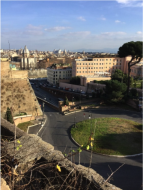
During the lunch break, Allain and I stretched our legs.
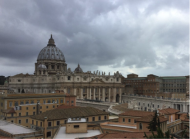
In the afternoon there was time for prayer, and then Mgr Orazio Pepe talked to us on the subject of The present and the future of the Federations. (It seems that the idea that federations have more ‘power’ than associations is false, and the two terms were used interchangeably.) Mgr Pepe is the Head of Office at the Congregation. He has a doctorate in Canon Law, started out as a parish priest, then spent 10 years at the Congregation for Divine Worship before being transferred to CICLSAL. He had clearly done a great deal of the organizational work for this event, and was omnipresent, always kind and good-humoured. He told us that since the symposium had been such a success they were considering doing something like it every three years. ‘But’, he said, ‘next time I’ll make sure that someone else is in charge of the buses!’
Mgr Pepe affirmed that the Church has always had a high esteem for nuns. For centuries, it was the sole form of consecration for women. The Church has therefore(!) regulated their life. Pius XII wrote Sponsa Christi at a time when many monasteries were in great difficulty after the war – some were in destitution. Federations were born from the changing circumstances – the need for sisters to move from one monastery to another, for monasteries to provide reciprocal help etc. Federations were not imposed but were ‘strongly recommended’ and were said to be ‘in some situations, necessary’.
The general aims were: fraternal assistance; economic aid; the ability to set up a common novitiate if desired; and encouraging communion between monasteries. Some responded to the invitation to federate but others to this day remain unfederated. There was not a strict obligation to federate but there was, and is, an obligation. Perfectae Caritatis confirmed the encouragement to federate wherever opportune. Is it only the community which can decide if it is ‘opportune’? Mgr Pepe would say no! Vita Consecrata (59) repeated the language of ‘encouragement’ respecting associations and federations. Verbi Sponsa (27-30) has very little to say on federations but holds them especially useful for formation. Verbi Sponsa is either a clear regression (Mgr Pepe’s view!) or a further clarification of Sponsa Christi.
A federation does not have any responsibility of government over federated monasteries. It is very rare for a monastery to ask for help to close. We must put aside our fears that autonomy will be compromised. When we make our profession, we renounce our autonomy. Then we reclaim it for the community! If we do this, we lose the gift that lies in communion.
Federations take their inspiration from the traditional monastic congregations, but they also differ from them. Congregations have established powers over each monastery regarding visitations and elections. Fairly recently CICLSAL established female monastic congregations.
Federations are structures to which monasteries (not individual nuns) belong. The most important structure is the General Assembly, attended by the prioress and a delegate of each monastery. A federation flourishes to the extent that it enjoys a climate of trust. Every monastery must recognize that is has a responsibility to the Order to foster communion. The president and council hold a position that gives them a deep knowledge of the monasteries and their needs. Federations have been a great help to the monasteries following Sponsa Christi. They have assisted with formation, the exchange of nuns, distribution of work, formation for formators, culture and spirituality (promoting and financing publications, centennial celebrations, courses etc., often seeing the nuns as authors, lecturers and so on). It is true that physical cloister suffers somewhat, but the true nature of the charism is respected.
Presently among all the Orders there are 166 federations, 47 associations, and 5 female monastic congregations. There are still entire Orders that have not begun to federate. ‘This is really terrible.’ There are also some nations in which specific Orders are not federated. The resistance is in part the result of preconceptions and bad past experiences. But this does not justify the abandonment of the federal process. The results have been very positive, and the Holy See has now taken the step of appointing people to promote the process. The nuns need to lift their gaze beyond their own communities to the needs of the Church, and beyond – all the way to the Blessed Trinity! The monastery must become a house and a school of communion. Otherwise autonomy could be transformed into fear, collective individualism etc. For this reason the need to federate must be put into legal language. Then we shall be able to deal with the great problem of everlasting superiors… AUTONOMY IN COMMUNION! AUTONOMY IN COMMUNION! AUTONOMY IN COMMUNION!
Relations with First Orders
The Congregation wrote to the male superiors in 2012 warning against intervention. [Note: Fr General sent us a copy of this letter. Clearly there is a certain tension between the Congregation and the Generalate. In the case of our present leadership, the letter of 2012 was really not called for; and Fr General’s talks at Minsteracres gave the other side of the picture – the need to maintain the unity of the charism.] The aim was to give the nuns the possibility of being protagonists in the future of their Orders and their federations. Pope Francis spoke in Evangelii Gaudium (104) of the need to give more space to the incisive contribution of women.
There is now a more mature awareness in the Church of the need to allow the consecrated themselves to make decisions regarding their life. The questionnaire sent out by the Congregation followed this direction; the method is important. In the responses there were naturally opposing positions. But the federated monasteries are all aware that isolation is detrimental; what happens to another monastery must concern me because it is part of my family. However, there is no lack of communities where the individualistic, charismatic aspect prevails over the aspect of communion. Such communities think that federation should be optional. Others think it should be obligatory. In our view, a federation is a valid instrument to stem the drift into isolation.
Visitations are important. Some problems are held too much within the cloister, and benefit from being exposed to an external gaze. Some monasteries suggested that presidents and council sisters should do visitations rather than bishops, since bishops sometimes fail to visit or do not understand or esteem the life. Certainly the bishop can delegate sisters. Likewise, many of the Fr Generals want more clarification about visitations. It is not necessary that friars should become guardians or that nuns should be subordinate, but that nuns and friars should work together.
Some suggested that the proceeds from monasteries that are sold should go into a federal fund. In order to hold goods, a federation must have juridical recognition by the state. Others suggested that monasteries that didn’t want to federate should be deprived of their sui juris status and made diocesan. The dicastery will be happy to receive further suggestions.
At this point Mgr Carballo returned (he was giving four talks around Rome that day), to answer a point that had been made in the morning, and a general discussion developed. Some traditions did not feel included in the designation ‘entirely contemplative life’, especially the ancient Benedictine tradition. He said they would try to make that great tradition recognized. Certainly it was not possible to treat all the Orders in the same way. He said: ‘You are a mosaic of the contemplative life of the Church. Be peaceful!’
Autonomy would not be taken away unless it was no longer there – e.g. in a monastery with three nuns. This was not right; a dignified death was important. ‘Give your life, if necessary, to defend your life of contemplation, but don’t give your life for other things.’
Mgr Pepe: 50 years ago a meeting like this was unimaginable. Sponsa Christi was not fully understood or taken up, but the obligation to federate remains.
Mgr Carballo: Pope Francis wanted to promulgate the new document during the Year of Consecrated Life but it was not possible. However, it will be soon.
We have got to give more power to the federations. The prioress is still the major superior. If the prioress can do it, then don’t ask permission! That’s not maturity. But the federation may see things a monastery can’t see.
The Congregation can’t contact all the monasteries in the world. The need to be federated is increasingly urgent. If there is not this trust, how can we speak about communion? The federation doesn’t take the place of the prioress, but there is a need to grow in authenticity. The federation must be the means of opening the monastery to the other monasteries and to the Church. More than 50% of the monasteries I know cannot offer formation. Why don’t they ask another monastery to form sisters? We cannot sacrifice young people in this way. I see too much isolation. Study the history of enclosure, how excessive isolation developed. Things change. Now you are obliged to go out. You no longer keep cows and hens! You have to look at things in a new light.
Mgr Pepe: The abbess of a congregation has much more power of government than the president of a federation. This is a choice you have to make, according to your Order. If your federation has reached a maturity which calls for the federation to be given more authority, then you can ask for it. The route is there, and requests will be considered case by case.
Pope Francis has said that what is important is what use cloister has for the Church and for humanity. What difference is there in practice between papal cloister and constitutional cloister? When you are living it, it doesn’t matter what the cloister is called.
The Apostolic Constitution will not please everyone. But documents are not eternal, and change is happening very fast.
The discussion continued until it was time to walk down and find our buses.

